
Story
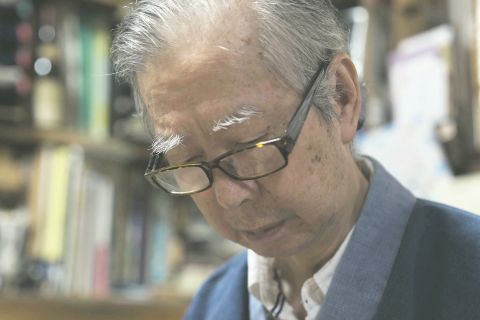
Born in Showa 22 (1947). His father, Tsunejirō, trained as a live-in apprentice under an Edo fan maker in Komagata, Asakusa, and became independent in Showa 26 (1951) in Kitashinozaki, Edogawa Ward, opening “Edo Sensu Kōbō Matsui.”
From childhood he helped his father's work, and at 20 began training under him. After working at a company, he returned to the family business and, at 30, devoted himself entirely to fan making. He says that after much hesitation he decided, “This is my calling.”
Kyoto fans are made through a division of labor, with a different craftsman for each process, whereas an Edo fan is made from base to finish by a single artisan. The steps include jibari (pasting the base paper), hiraguchi-hiraki (opening the flat mouth), ori (folding), nakasashi (inserting the middle ribs), tsugikomi (joining), makiri (true cutting), sakizome (tip dyeing), fuki (blowing), nakazuke (middle soaking), arauchi (rough striking), sakitsumi (tip trimming), tame (straightening) and oya-tsuke (attaching the outer ribs). Repeating the cycles of dampening and drying, more than 30 steps are needed to complete a single fan.
Edo Sensu are said to have begun when the fan was introduced from Kyoto during the Genroku era. Compared with the ornate Kyoto fans, they are chic and sleek, made from just 15 bamboo ribs and washi paper. They close with a crisp snap, and have long been used as the fans of rakugo performers on the yose stage.
Made to order from mame-ogi to chūkei. Besides hand fans, dance fans, commemorative fans, and decorative fans, there are designs with seasonal plants and flowers, zodiac animals, goldfish, morning glories, and fireworks, as well as fans to match yukata. The “gradation fan,” developed with art university students, has one side shortened so it does not catch the kimono sleeve when fanned, and has been loved for a long time.
Edo fan artisans in Tokyo numbered more than 20 until the 1970s–80s, but their number has dwindled. In Edo-gawa Ward, Mr. Matsui alone continues to protect the craft handed down since the Edo period. In 2004 (Heisei 16), he was registered as a holder of an Edo-gawa Ward designated Intangible Cultural Property.
It took ten years before the form was finally complete. From there, one's own individuality, sensibility and attention to detail keep building on it. There is no point where it is ‘good enough.’ I am still training myself even now.